
If you’ve been paying every bill on time, never missed a payment, and still your credit score isn’t moving…
You’re not alone.
In the USA, one of the biggest “silent score killers” is not late payments — it’s high credit card utilization.
And the worst part?
👉 Utilization can keep your FICO score locked in a credit jail even if you’re financially responsible.
Today I’ll share a simple method (used by many credit pros) that can help you see real results within 45 days (one billing cycle):
✅ lower utilization
✅ cleaner credit report
✅ possible score jump (often 20–50+ points depending on your profile)
Let’s break it down.
The Hook: Why High Utilization Keeps Your Score in “Jail”
Here’s the truth:
Credit utilization is one of the biggest factors in your credit score.
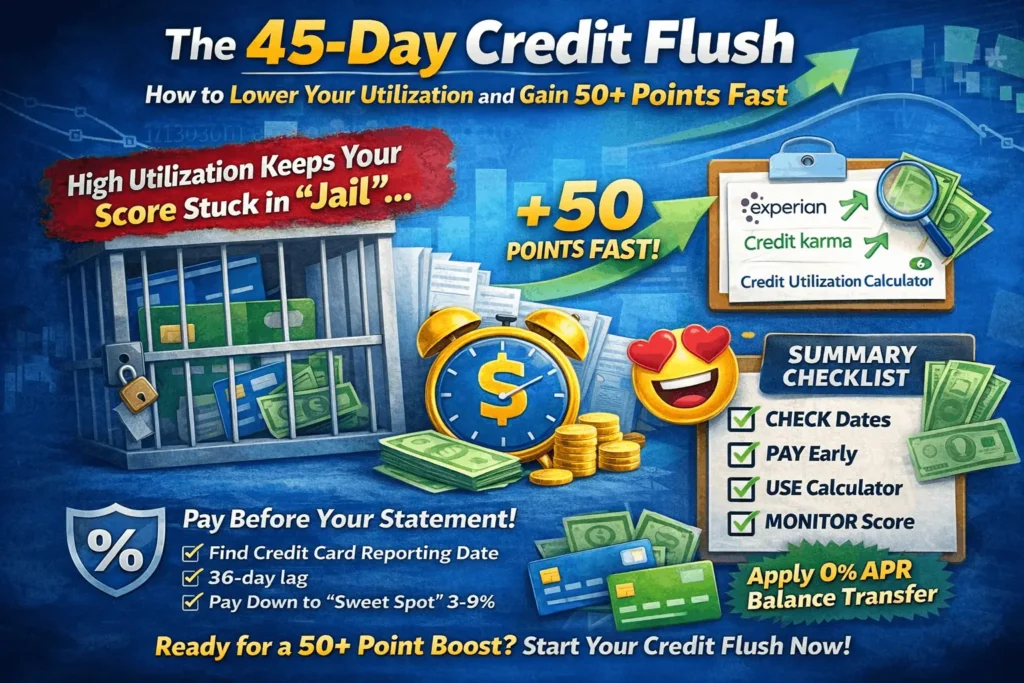
So even if you’re doing this:
✅ Paying your credit card on time
✅ Paying minimum + extra
✅ Never missing payments
…but your balances are still showing high every month, the credit system reads it as:
🚨 “This person is depending on credit.”
That’s why someone with zero missed payments can still have:
- 620 score
- 650 score
- 680 score
…and feel completely stuck.
The Promise: A 45-Day Strategy That Shows Results Fast
This is not a “get rich quick” trick.
This is a credit reporting timing strategy.
Because FICO does NOT care only about what you owe…
It also cares about what gets reported.
And that depends on the statement closing date, not the due date.
That’s why this method works within one credit card reporting cycle (about 30–45 days).
The “Pre-Statement Payment” Trick (Most People Miss This)
✅ Due Date vs Reporting Date (Statement Closing Date)
Let’s make it super simple:
1) Payment Due Date
This is the deadline to avoid:
- late fee
- penalty APR
- negative mark on credit report
2) Reporting Date (Statement Closing Date)
This is the day your credit card generates the statement.
📌 Whatever balance exists on this date is the balance most banks report to the credit bureaus.
So even if you pay in full later…
Your score may already be affected because the balance was reported.
✅ The Trick: Pay BEFORE the statement closes
Instead of paying on the due date…
You make a “pre-statement payment”:
✅ 3–5 days before the statement closing date
✅ bring balance down to the target (sweet spot)
✅ let the statement generate with a low balance
This sends the credit scoring system a completely different signal.
What signal does this send to banks and credit systems?
When you pay early, it often signals:
✅ low risk
✅ controlled spending
✅ credit used responsibly
✅ not over-dependent on revolving debt
This is why many people see fast improvements after doing this for 1–2 cycles.
The Math of the “Sweet Spot” (The Score Boost Zone)
Now here is the most important section.
Most people think:
“If I show 0% utilization, that should be the best!”
Surprisingly…
❌ 0% utilization isn’t always the best
A reported balance of $0 on all cards can sometimes slightly reduce your score potential because it looks like:
➡️ you’re not using revolving credit at all
✅ The Sweet Spot: 1% to 9%
Credit experts commonly recommend reporting:
📌 1% to 9% utilization
Even better: 1% to 3% (for max scoring)
This means:
- not too high (risk)
- not zero (inactive)
It’s the perfect “active + responsible” signal.
Use our Credit Utilization Calculator (Target Balance Finder)
To do this correctly, you need to calculate:
✅ overall utilization
✅ per-card utilization
✅ exact target balance for 1%–9%
👉 Use our Credit Utilization Calculator to find your ideal balance range and avoid mistakes.
Example:
If your total credit limit is $10,000:
- 1% = $100
- 3% = $300
- 9% = $900
So your goal is to report somewhere in that range (depending on your credit profile).
The 45-Day Credit Flush Plan (Step-by-Step)
Here’s the simple plan:
✅ Step 1: Find every card’s Statement Closing Date
Go to:
- card app
- last PDF statement
- billing info section
Write it down.
✅ Step 2: Pay down balances BEFORE the statement closes
For each card:
✅ pay down balance 3–5 days before closing
✅ don’t wait for due date
✅ repeat for all cards
✅ Step 3: Keep utilization in the 1%–9% zone
Target:
- Individual card utilization under 10%
- overall utilization under 10%
This is where most “quick score jumps” happen.
Strategic Debt Shifting (If You Can’t Pay It All Off)
Let’s be real:
Sometimes you want to pay down utilization… but cash is tight.
If that’s the case, you can still improve utilization using smart moves.
1) Request a credit limit increase
This lowers utilization without paying extra.
Example:
- balance: $2,000
- limit: $4,000 → utilization 50%
- limit increased to $8,000 → utilization becomes 25%
📌 This is a big difference in scoring.
2) Balance Transfers (Smartest option if you qualify)
If you have balances you can’t pay quickly:
✅ move debt to a 0% APR balance transfer card
✅ lower utilization on high cards
✅ reduce interest pressure
Popular US cards that often offer 0% APR balance transfer promos include:
- Chase
- Citi
- Bank of America
- Discover
- Wells Fargo
(Offers depend on your credit profile and change frequently.)
💡 Key: Don’t apply for too many cards at once—hard inquiries can temporarily reduce score.
The “Rapid Recheck” Tools (Monitor Fast)
Once you apply this method, you’ll want to check updates quickly.
✅ Credit Karma
Good for monitoring:
- utilization updates
- reported balances
- trends
✅ Experian Boost
Can help by adding positive payment history, like:
- phone bill
- utilities
- streaming payments
📌 It doesn’t work for everyone, but many users see improvement.
Summary Checklist (Scan & Apply)
Here’s your quick “45-Day Credit Flush” checklist:
✅ Check statement closing dates (NOT due dates)
✅ Pay early (3–5 days before close)
✅ Keep 1%–9% utilization (don’t report zero)
✅ Use Credit Utilization Calculator to set target balance
✅ Monitor updates (Credit Karma / Experian)
✅ Repeat for 1–2 billing cycles
Final Thoughts: This Works Because Timing Matters
The credit game isn’t only about paying debt.
It’s about what your credit report shows at the right moment.
Once you control statement timing + utilization percentage, you can unlock points that were hidden behind high reported balances.
